
There's good news and there's bad news. The bad news is that I've been pretty much stalled on Tempest for the better part of two months. The good news is that I discovered that my story had problems before I'd written 100K. I was only half way there.
I've spent the past couple of weeks going through many of the lessons in the How to Think Sideways course from Lesson 7 through 16. This time I've actually done the assignments instead of just reading them :P I also have open (and am working back and forth between) Create a Character Clinic and Create a Plot Clinic, also both by Holly Lisle.
I wish I didn't have to report that I've removed every scene from Aben's viewpoint in the draft thus far. (I moved them to an out-take file, so don't panic. They're not deleted! But I doubt there will be much in them I can re-use.) You'll notice Tempest's status bar on the right went from 47571 to 33618.
I've deleted all Aben's plot cards, completed and *future*. I found out that I'd written a character whose one redeeming feature is that he's a hard worker. He's also full of himself, afraid of heights, and a whiner. How did I not notice this months ago? I have no answer for that. I'm trying to hang onto the fact that I AM seeing it now, before I've finished the novel, before my crit partners look at him and go *huh*?
It's a bit humbling to find myself a third finished a first draft I thought I was half done. It's a bit humbling to find myself making such a simple but complex error when this is my eighth novel. But I'm trying to look on the bright side. Reading through the entire draft this week, Tempest herself is fairly strong. She has a strong voice and she certainly has conflict in every scene and she has a lot at stake in this novel. Sure there will be stuff to revise--it's not perfect--but I'm not throwing out anything but Aben's scenes at this time. I can work with Tempest as a character.
But my job for the next few days is to recreate Aben into a worthy love interest. Sure he needs a flaw or two, but he needs more positives than a good work ethic. Honestly. Where's the romance in that? :P
Thursday, November 27, 2008

Wednesday, November 26, 2008
More on petroglyphs/ pictographs
Technically the correct term is pictograph for rock paintings. Petroglyph seems to mean rock carvings, though around here and around the web I hear/ see petroglyph for both most of the time. In googling the words pictograph and Kootenay I did find additional information, including this site, which shows this sketch (click on it to see the whole thing):

With a shock of recognition I realized it was the pictographs we found on Sunday, though we couldn't find a *guide* to tell us what the letters on the sketch represent. But apparently just fifty feet south is another (smaller) set, so apparently we have to go back and find them. The other pictographs mentioned on the above linked page (site 76) are the ones we found last month. I've gone back and added a *pictograph* label to keep these types of posts linked. (Wonder what book I'm writing or could write might have these in it?)
We've suddenly become much more interested in the history of our area. Go figure.

With a shock of recognition I realized it was the pictographs we found on Sunday, though we couldn't find a *guide* to tell us what the letters on the sketch represent. But apparently just fifty feet south is another (smaller) set, so apparently we have to go back and find them. The other pictographs mentioned on the above linked page (site 76) are the ones we found last month. I've gone back and added a *pictograph* label to keep these types of posts linked. (Wonder what book I'm writing or could write might have these in it?)
We've suddenly become much more interested in the history of our area. Go figure.
Monday, November 24, 2008
Petroglyphs
A month or so ago we found petroglyphs on a geocaching trip. After that we heard a rumor about another set of them in our valley, so we went hunting them this weekend.
On Saturday we walked along the road where we could see the hillside and plot out possible locations in the right area. There were two sets of bluffs that *might* hold these ancient rock paintings. On Sunday afternoon we headed north on the railway tracks until we came to a cairn. Then we angled down.

We found ourselves on the wrong side of a swamp, but we could just make out the red splotches on the rocks opposite us. See right in the center of the photo? (If you click on the photo, you'll get the big version!) But we couldn't get to them without getting a soaking, and in late November (even a sunny day!) I wasn't keen on that.

So we retraced our steps, found a place we could climb back up to the tracks--STEEP!!!--and followed them through the rock cut and found another trail (fairly easy one) down again on the other side. The ground was a little squoodgy here too, but not under water. We made our way back along the bottom of the cliff, then Jim climbed up to take a few shots. Though I could see the splotches from down below, I couldn't make out the shapes. Jim was calling out, oh, bugs!

Look, there's a dog or a wolf or something!

And a sun...

So of course I had to climb up and have a look for myself! It was a much easier climb than the ones from last month. I was pretty sure I wasn't going to fall and die this time, anyway. (Yeah I'm chicken and afraid of heights. So be it.)

Then it was a long walk back to the truck, and we got home just at dark. But what a cool day!
On Saturday we walked along the road where we could see the hillside and plot out possible locations in the right area. There were two sets of bluffs that *might* hold these ancient rock paintings. On Sunday afternoon we headed north on the railway tracks until we came to a cairn. Then we angled down.

We found ourselves on the wrong side of a swamp, but we could just make out the red splotches on the rocks opposite us. See right in the center of the photo? (If you click on the photo, you'll get the big version!) But we couldn't get to them without getting a soaking, and in late November (even a sunny day!) I wasn't keen on that.

So we retraced our steps, found a place we could climb back up to the tracks--STEEP!!!--and followed them through the rock cut and found another trail (fairly easy one) down again on the other side. The ground was a little squoodgy here too, but not under water. We made our way back along the bottom of the cliff, then Jim climbed up to take a few shots. Though I could see the splotches from down below, I couldn't make out the shapes. Jim was calling out, oh, bugs!

Look, there's a dog or a wolf or something!

And a sun...

So of course I had to climb up and have a look for myself! It was a much easier climb than the ones from last month. I was pretty sure I wasn't going to fall and die this time, anyway. (Yeah I'm chicken and afraid of heights. So be it.)

Then it was a long walk back to the truck, and we got home just at dark. But what a cool day!
Saturday, November 22, 2008
Friday, November 21, 2008
Progress?
If you've been hanging around for long you may have noticed that my main wip, Tempest, has been stalled for awhile. I've been wrestling with how to fix the problems I see and move forward. And in between I've been writing on Dottie and wandering Facebook and Twitter and forums and ignoring the whole mess. And I'd like to write professionally? Um. Not a good habit I've slid into.
So ignoring it doesn't work, and poking it with a stick doesn't work. What does? I've been taking Holly Lisle's 'How to Think Sideways' course for several months now. She's been covering these mired-in-the-middle novels for the last few weeks. I read the lesson and think, interesting what works for her. That would never work for me.
What DOES work for me?
Exactly. I don't know.
So why am I paying her for her experience and advice and then dismissing it? That makes a lot of sense. I haven't got anything to lose by following her plan--and everything to gain. So this week I've bought new printer ink, printed out the lessons I hadn't yet, and began studying the ones I'd only glossed over. I think the reason I wasn't paying close attention was that it looked like a lot of work. Still does. But at least now I'm applying them and working my way through her steps, starting with printing out the 143 pages of manuscript already written (about 48K). Meanwhile I'm reading through the sample novels she's included in the course, ones she turfed and started over on, trying to figure out where she went wrong, where she went right, trying to apply the insights to Tempest.
If all else fails, take a pro's advice. Working on it.
So ignoring it doesn't work, and poking it with a stick doesn't work. What does? I've been taking Holly Lisle's 'How to Think Sideways' course for several months now. She's been covering these mired-in-the-middle novels for the last few weeks. I read the lesson and think, interesting what works for her. That would never work for me.
What DOES work for me?
Exactly. I don't know.
So why am I paying her for her experience and advice and then dismissing it? That makes a lot of sense. I haven't got anything to lose by following her plan--and everything to gain. So this week I've bought new printer ink, printed out the lessons I hadn't yet, and began studying the ones I'd only glossed over. I think the reason I wasn't paying close attention was that it looked like a lot of work. Still does. But at least now I'm applying them and working my way through her steps, starting with printing out the 143 pages of manuscript already written (about 48K). Meanwhile I'm reading through the sample novels she's included in the course, ones she turfed and started over on, trying to figure out where she went wrong, where she went right, trying to apply the insights to Tempest.
If all else fails, take a pro's advice. Working on it.
Tuesday, November 18, 2008
Shade by John Olson Day 2
Yesterday I promised to tell you why I didn't order up Shade by John Olson when I had the opportunity to get a free preview copy. Well, first off you know I'm not really into scary. It's hard to know how scary something is going to be, though, unless you hear a personalized testimonial. (Even then you may not be sure, but it helps!)
Randy Ingermanson has co-authored a couple of books with John Olson and they are, apparently, quite good friends. And in April I attended a workshop taught by Randy. In it, he told us how excited he was for his buddy, and then told us the following story about Shade (which Randy has posted on his blog here and which I am shamelessly stealing):
Here is your chance to prove you are a deeper reader than me. Someone who "gets it"--whatever "it" is.
Have you read Shade? If not, does Randy's recommendation make you want to read it? Or, like me...chicken out?
Randy Ingermanson has co-authored a couple of books with John Olson and they are, apparently, quite good friends. And in April I attended a workshop taught by Randy. In it, he told us how excited he was for his buddy, and then told us the following story about Shade (which Randy has posted on his blog here and which I am shamelessly stealing):
In any event, as John’s writing buddy, I read SHADE at a physics conference in 1999. I finished it about 1 AM and went to bed. But I couldn’t sleep, so I turned on the light and checked in the bathtub for vampires. (They hide there sometimes.) I checked under the sink. I checked in the medicine cabinet. (You probably know about mirrors.) Then I went back to bed.
But I still couldn’t sleep, so I turned on the light and checked the room thoroughly again. Then I went back to bed.
But I STILL couldn’t sleep, so I made one last check. Those vampires can be sneaky little devils. After an extremely careful check, I went back to bed.
BUT I STILL COULDN’T SLEEP. So I turned on the light. And left it on all night. I can’t sleep with the light on, so I was a wreck the next day. But the point is that I survived the night.
All that was ten years ago. I’m now halfway through SHADE and you know what? It’s scarier this time. It’s better written. (I’ll take credit for that. John learned everything he knows from me. Ya heard it here first.)
Bottom line: SHADE is probably the spookiest book you’ll read all year. DO NOT read this book if you can’t take spooky. It also takes a bit of brain-power to “get it.” DO NOT read this book if you are a shallow reader who won’t “get it.”
Here is your chance to prove you are a deeper reader than me. Someone who "gets it"--whatever "it" is.
Have you read Shade? If not, does Randy's recommendation make you want to read it? Or, like me...chicken out?
Monday, November 17, 2008
Shade by John Olson
So this month the Christian Science Fiction Fantasy Blog Tour is reviewing Shade.
I was looking for the direct link to the trailer, so you'd understand why I didn't order this book for review, but the direct link seems to be broken. You can go here and scroll down to view it.
The author, John Olson has several other books available, some co-authored with Randy Ingermanson. Tomorrow I'll tell you the REAL reason I didn't order this book! Meanwhile, have a look at what the other tour members are saying:
Brandon Barr, Jennifer Bogart , Justin Boyer, Keanan Brand, Kathy Brasby, CSFF Blog Tour, Stacey Dale, Janey DeMeo, Jeff Draper, April Erwin, Karina Fabian, Todd Michael Greene, Katie Hart, Joleen Howell, Jason Isbell, Jason Joyner, Kait, Magma, Margaret, Rachel Marks, Melissa Meeks, Rebecca LuElla Miller, Eve Nielsen, Nissa, John W. Otte, Steve Rice, Mirtika or Mir's Here, Chawna Schroeder, James Somers, Robert Treskillard, Steve Trower, Speculative Faith, Jason Waguespac, Laura Williams, Timothy Wise
I was looking for the direct link to the trailer, so you'd understand why I didn't order this book for review, but the direct link seems to be broken. You can go here and scroll down to view it.
The author, John Olson has several other books available, some co-authored with Randy Ingermanson. Tomorrow I'll tell you the REAL reason I didn't order this book! Meanwhile, have a look at what the other tour members are saying:
Brandon Barr, Jennifer Bogart , Justin Boyer, Keanan Brand, Kathy Brasby, CSFF Blog Tour, Stacey Dale, Janey DeMeo, Jeff Draper, April Erwin, Karina Fabian, Todd Michael Greene, Katie Hart, Joleen Howell, Jason Isbell, Jason Joyner, Kait, Magma, Margaret, Rachel Marks, Melissa Meeks, Rebecca LuElla Miller, Eve Nielsen, Nissa, John W. Otte, Steve Rice, Mirtika or Mir's Here, Chawna Schroeder, James Somers, Robert Treskillard, Steve Trower, Speculative Faith, Jason Waguespac, Laura Williams, Timothy Wise
Sunday, November 16, 2008
Reading Meme
 Is November National Meme month? No? You'd think! Rebecca Miller tagged me on this one: Seven random book related facts. Okeydokey, I can do that!
1. My sister taught me to read from Dick and Jane. I remember us lying on our tummies on the bed in the attic bedroom. Thankfully other books had more interesting plot lines.
2. We lived in a remote rural area and got our library books by mail from the University of Manitoba.
3. The first year I attended a school with a library in it was seventh grade. Before that, books were just in a cupboard at the back of the classroom. (No wonder I learned to reread...)
4. Books were a common gift for birthdays and Christmas. Heidi, The Five Little Peppers, The Borrowers.
5. It's my husband's fault I *really* got into SFF, though. He started me on Anne McCaffery and I've never looked back!
6. Our kids learned to read *defensively*. That was what Mommy and Daddy were doing, so it must be fun!
7. I think it is the coolest thing these days to go into bookstores and realize I actually KNOW some of the authors on the shelf. They're people I've exchanged emails with or met through book tours or forums, a few even in person.
Seven folks whose responses to this meme I would like to see are:
1. Hanna
2. Karen
3. Bonne
4. Fiorinda
5. Mirtika
6. EJ
7. Maripat
Saturday, November 08, 2008
Hero, Second Class by Mitchell Bonds
On October first, Marcher Lord Press released its premier offerings: three speculative novels from a Christian worldview. I ordered two, and just finished reading Hero, Second Class by Mitchell Bonds.
Hero, Second Class is the story of apprentice hero, Cyrus Solburg, encompassing his years of training with Sir Reginald Ogleby, also known as The Crimson Slash, and his first solo quest as a Hero, Second Class. Reg has a habit of narrating his own battles (and asking Cyrus to record them, please) because, he says: (p 56)"You think I'd trust some half-wit bard who's never held a sword to accurately describe epic combat? You might as well ask a blind poet!" It's Reg's job to teach Cyrus everything he needs to know to become a hero in his own right, even if the First Thing about being a hero changes every time Reg thinks of something new.
Here's a sample (p 76-77):
Methinks that gives you a bit of a taste of Bonds' voice in this rollicking fantasy spoof. This is a land where Capital Letter and Assymetrical Numbers add strength to magical spells, where Villains band together under an Arch Villain to take over the world, and where Cyrus, with his unusual abilities, is forced to make an impossible choice of who he will save in the final battle.
But is it the final battle? Of course not. Hero, Second Class is Book 1 of The Hero Complex. I, for one, will be around for Book 2.
Reminiscent of Patricia Wrede's The Enchanted Forest Chronicles, this novel can be enjoyed by folks of any age, but is complex and witty enough to be appreciated by adults. I enjoyed a novel that allowed me to read a few chapters at a time, but that I always wanted to come back to.
If you enjoy spoofs, puns and tongue-in-cheek humor, pick up Hero, Second Class. I'm pretty sure you'll be glad you did!
Hero, Second Class is the story of apprentice hero, Cyrus Solburg, encompassing his years of training with Sir Reginald Ogleby, also known as The Crimson Slash, and his first solo quest as a Hero, Second Class. Reg has a habit of narrating his own battles (and asking Cyrus to record them, please) because, he says: (p 56)"You think I'd trust some half-wit bard who's never held a sword to accurately describe epic combat? You might as well ask a blind poet!" It's Reg's job to teach Cyrus everything he needs to know to become a hero in his own right, even if the First Thing about being a hero changes every time Reg thinks of something new.
Here's a sample (p 76-77):
"Who just counterspelled me?" he (the villain mage) demanded.
Cyrus smiled. "Over here, Shorty. You want to use magic? Try me."
The mage smiled back, though in a decidedly more evil fashion. "Insolent whelp! I'll show you a thing or Five."
As he pronounced the last word, he flung his hands out, twisting his arms as he did so. His thin wisp of beard blew forward in the backwash as five fragments of flaming frost flashed through the air.
Cyrus had time to either scream or drop to the ground before the ice reached him. He opted for the latter, flinging himself into the snowbank. The inexplicably incandescent icicles passed overhead, smashing harmlessly against a large rock.
A slash of flame rent the newly chilled air and carbonized the mage's hiding-tree. Keeth (dragon) waded out of the drift, shivering massively. "I d-don't l-l-like c-c-cold!"
The Crimson Slash drew himself up to his full Heroic six foot four inches, not counting the boots, and pointed his sword at the now-exposed mage. "Frostbite! I challenge you to a Hero's Combat! Stand your ground!"
Cyrus clapped a hand to his head. Not again, he thought.
The Villain turned slightly aside. "You do? I didn't expect that. Very well. I must use the most powerful spell I have left."
The Crimson Slash shifted his shield to Spell Blocking Position Delta.
"Teleport!" the mage yelled.
"No!" shouted the Crimson Slash, lunging forward.
"Bok in a bucket," Cyrus muttered.
The mage vanished in a shimmer of powdery snow.
"By the Seven Furies..." sputtered Reginald.
Methinks that gives you a bit of a taste of Bonds' voice in this rollicking fantasy spoof. This is a land where Capital Letter and Assymetrical Numbers add strength to magical spells, where Villains band together under an Arch Villain to take over the world, and where Cyrus, with his unusual abilities, is forced to make an impossible choice of who he will save in the final battle.
But is it the final battle? Of course not. Hero, Second Class is Book 1 of The Hero Complex. I, for one, will be around for Book 2.
Reminiscent of Patricia Wrede's The Enchanted Forest Chronicles, this novel can be enjoyed by folks of any age, but is complex and witty enough to be appreciated by adults. I enjoyed a novel that allowed me to read a few chapters at a time, but that I always wanted to come back to.
If you enjoy spoofs, puns and tongue-in-cheek humor, pick up Hero, Second Class. I'm pretty sure you'll be glad you did!
One Word Meme
I snatched this off my daughter's site and because I'm in the mood to procrastinate today, thought I'd play along!
Where is your mobile phone? purse
Where is your significant other? recliner
Your hair colour? brown
Your mother? aged
Your father? gone
Your favourite thing? writing
Your dream last night? nonexistant
Your dream goal? published
The room you're in? cozy
Your hobby? walking
Your fear? obscurity
Where do you want to be in 6 years? here
Where were you last night? home
What you're not? patient
One of your wish-list items? travel
Where you grew up? Manitoba
The last thing you did? shower
What are you wearing? clothes
Your TV? off
Your pets? snoozing
Your computer? MacBook :)
Your mood? procrastinating
Missing someone? kids
Your car? broken
Something you're not wearing? shoes
Favourite shop? bookstore
Your summer? gardening
Love someone? YES!
Your favorite colour? sage
When is the last time you laughed? today
When is the last time you cried? dunno
If you want to play along, post a note in comments! It only takes a couple of minutes.
Where is your mobile phone? purse
Where is your significant other? recliner
Your hair colour? brown
Your mother? aged
Your father? gone
Your favourite thing? writing
Your dream last night? nonexistant
Your dream goal? published
The room you're in? cozy
Your hobby? walking
Your fear? obscurity
Where do you want to be in 6 years? here
Where were you last night? home
What you're not? patient
One of your wish-list items? travel
Where you grew up? Manitoba
The last thing you did? shower
What are you wearing? clothes
Your TV? off
Your pets? snoozing
Your computer? MacBook :)
Your mood? procrastinating
Missing someone? kids
Your car? broken
Something you're not wearing? shoes
Favourite shop? bookstore
Your summer? gardening
Love someone? YES!
Your favorite colour? sage
When is the last time you laughed? today
When is the last time you cried? dunno
If you want to play along, post a note in comments! It only takes a couple of minutes.
Wednesday, November 05, 2008
Learning to stop when stuck
You'd think a stuck person would automatically stop. It pretty much works on vehicles, doesn't it? I guess not entirely--one can spin tires and slide sideways and make a small amount of forward motion for the price of a lot of fuel.
Same can be with writing. I've been more-or-less stuck on Tempest for the past couple of weeks. I can see the rough shape of what needs doing to it to un-stick it, but the sheer amount of work has had me stalled. It's not work itself I'm afraid of. More the fact that while I'm shuffling things, I could lose parts and have a hard time putting the parts back into some kind of a whole. Pathetically, that means I seem to prefer a flawed whole over a shredded-but-possibly-closer whole. (Whole not meaning whole as in an entire novel. More like meaning the whole of what I've written so far.)
Today's lesson from the How to Think Sideways workshop by Holly Lisle is about middles that go awry and some tips on how to deal with them. How to recognize the issues and find solutions.
I'm almost glad I've stalled out and been taking the easy way of working on another project, just ignoring Tempest for the time being. You see, I want to FIX Tempest. Holly's advice (which I've seen in her other workshops) tends more to analyzing the problem, figuring out what you should have done, making notes on it, and then CARRYING ON as though you've already fixed it.
Yup.
Keep going all the way to the end, then use your notes as the beginning of your revision guide.
But I want to fix it now. Well, in theory. Really I want to already have fixed it. But I haven't.
Meanwhile I've been having a great time with Dottie, writing from one to two thousand words a day. I need to get back to Tempest, though. It's like she's standing on the side, watching, waiting. Ready to take the baton from Dottie and carry the next lap herself.
Maybe next week.
Same can be with writing. I've been more-or-less stuck on Tempest for the past couple of weeks. I can see the rough shape of what needs doing to it to un-stick it, but the sheer amount of work has had me stalled. It's not work itself I'm afraid of. More the fact that while I'm shuffling things, I could lose parts and have a hard time putting the parts back into some kind of a whole. Pathetically, that means I seem to prefer a flawed whole over a shredded-but-possibly-closer whole. (Whole not meaning whole as in an entire novel. More like meaning the whole of what I've written so far.)
Today's lesson from the How to Think Sideways workshop by Holly Lisle is about middles that go awry and some tips on how to deal with them. How to recognize the issues and find solutions.
I'm almost glad I've stalled out and been taking the easy way of working on another project, just ignoring Tempest for the time being. You see, I want to FIX Tempest. Holly's advice (which I've seen in her other workshops) tends more to analyzing the problem, figuring out what you should have done, making notes on it, and then CARRYING ON as though you've already fixed it.
Yup.
Keep going all the way to the end, then use your notes as the beginning of your revision guide.
But I want to fix it now. Well, in theory. Really I want to already have fixed it. But I haven't.
Meanwhile I've been having a great time with Dottie, writing from one to two thousand words a day. I need to get back to Tempest, though. It's like she's standing on the side, watching, waiting. Ready to take the baton from Dottie and carry the next lap herself.
Maybe next week.
Tuesday, October 28, 2008
Re-re-replotting
Does this happen to anyone but me? Every single time I feel like I'm home free, that I have a solid outline and am confident that the story from here on in makes sense, I hit a wall.
Every. Single. Time.
I'm writing a structured novel, which is likely a mistake to start with. Every chapter has three scenes, two from Tempest's viewpoint, and one from Aben's. They start out the story in the same location, and will (I think!) end it there. But in between, the threads are somewhat independent.
This means that two independent story lines must both have a similar amount going on, similar amounts of tension and disasters. It's hard to keep this balanced. Today I got to the next scene of Aben's in the outline, and it's horrible. Not only that, but he's practically treading water for the next few chapters waiting for the big slide into the inevitable that signals the beginning of the end.
My first impulse is to just write him out of the story. You know, drown him or something. But it's kinda hard to have romantic fantasy without the male lead character, and besides, the story has plenty of tragedy already. I think the boy needs to live. (Probably unmaimed...though that gives an idea...)
So I pulled out Holly Lisle's Create a Plot Clinic. She's got it laid out in three main sections: Plotting Before Writing, Plotting While Writing, and Plotting While Revising.
Clearly I need the middle one. I open it and read this:
Yep. Holly has pretty much nailed where I'm at. I have a few glimmerings of ideas but nothing that looks concrete. In fact, my thoughts at the moment are quite will'o'wisp. When I look straight at them, there's nothing there, but if I look sideways, pretending I don't care, there is *almost* something over there.
Back to reading the plot clinic. Hopefully something will coax those will'o'wisp thoughts out where they can be scrutinized.
Every. Single. Time.
I'm writing a structured novel, which is likely a mistake to start with. Every chapter has three scenes, two from Tempest's viewpoint, and one from Aben's. They start out the story in the same location, and will (I think!) end it there. But in between, the threads are somewhat independent.
This means that two independent story lines must both have a similar amount going on, similar amounts of tension and disasters. It's hard to keep this balanced. Today I got to the next scene of Aben's in the outline, and it's horrible. Not only that, but he's practically treading water for the next few chapters waiting for the big slide into the inevitable that signals the beginning of the end.
My first impulse is to just write him out of the story. You know, drown him or something. But it's kinda hard to have romantic fantasy without the male lead character, and besides, the story has plenty of tragedy already. I think the boy needs to live. (Probably unmaimed...though that gives an idea...)
So I pulled out Holly Lisle's Create a Plot Clinic. She's got it laid out in three main sections: Plotting Before Writing, Plotting While Writing, and Plotting While Revising.
Clearly I need the middle one. I open it and read this:
This is the most common scenario. You're somewhere in the middle of the writing and you hit a bad plot card. It sounded like a great idea at the time, or maybe it only sounded like an iffy idea at the time but you put it in there anyway, confident that when you got to it, you'd be so into the story that you could make it work. Only now you and your Muse look at each other and go, "Uh-uh. Not gonna do it."
Yep. Holly has pretty much nailed where I'm at. I have a few glimmerings of ideas but nothing that looks concrete. In fact, my thoughts at the moment are quite will'o'wisp. When I look straight at them, there's nothing there, but if I look sideways, pretending I don't care, there is *almost* something over there.
Back to reading the plot clinic. Hopefully something will coax those will'o'wisp thoughts out where they can be scrutinized.
Monday, October 27, 2008
Multi-tasking
This is something I'm really good at in Real Life, and not so good at in writing. Why? I'm guessing because each story I work on requires a certain depth of thought immersion. It's not easy to dip in lightly and then off to something else, at least not if I want to make progress. And of course I do! Also there's the idea that each project takes so very long that if you mix two or more of them, it'll take twice as long to get anywhere.
The only time I've tried two first drafts was about four years ago when I did NaNo for the first time. I hadn't finished my previous novel when NaNo started, so I dropped everything for the new novel (to officially participate in NaNo, you need to begin and write a novel you haven't previously started). At the end of November I had two partially completed novels and then spent several months alternating between the two to finish both first drafts. It was difficult and I vowed never to do it again.
Even playing with world-building or revising one while writing on another is difficult for me. All of these areas require a real depth of focus that makes it hard to shift gears from one to the other. I've been trying to learn how to do this better, especially in the last couple of years where I've been spending so much more time revising and therefore feeling stifled without the *rush* of creating that a first draft brings.
I started writing Tempest in July, thinking that once I got rolling on it, I'd pull out one of my older novels to revise. I tend to write in the mornings (my best time), then, the idea was, spend the afternoon on revising. I haven't started a revision project, though. Instead I started taking the Thinking Sideways class and bounced some new ideas around for that, then resurrected an old partial first draft--Dottie.
And now I'm finding myself doing the unthinkable and actually enjoying it: having two first drafts on the go at once. It helps, I think, that they're quite opposite stories. Tempest is fantasy set in a harsh environment. Dottie is contemporary women's fiction and quite humorous at times. So when I find that Tempest depresses me, I can switch gears and work on something fluffier.
This has been working well for the past couple weeks. I'm making steadier progress on Tempest and plan to keep it the higher priority until the draft is done. At this rate, that should be sometime in December, but if it takes longer, so be it.
I guess this means that I'm not revising anything more until next year. Two projects is ample to keep me out of trouble!
The only time I've tried two first drafts was about four years ago when I did NaNo for the first time. I hadn't finished my previous novel when NaNo started, so I dropped everything for the new novel (to officially participate in NaNo, you need to begin and write a novel you haven't previously started). At the end of November I had two partially completed novels and then spent several months alternating between the two to finish both first drafts. It was difficult and I vowed never to do it again.
Even playing with world-building or revising one while writing on another is difficult for me. All of these areas require a real depth of focus that makes it hard to shift gears from one to the other. I've been trying to learn how to do this better, especially in the last couple of years where I've been spending so much more time revising and therefore feeling stifled without the *rush* of creating that a first draft brings.
I started writing Tempest in July, thinking that once I got rolling on it, I'd pull out one of my older novels to revise. I tend to write in the mornings (my best time), then, the idea was, spend the afternoon on revising. I haven't started a revision project, though. Instead I started taking the Thinking Sideways class and bounced some new ideas around for that, then resurrected an old partial first draft--Dottie.
And now I'm finding myself doing the unthinkable and actually enjoying it: having two first drafts on the go at once. It helps, I think, that they're quite opposite stories. Tempest is fantasy set in a harsh environment. Dottie is contemporary women's fiction and quite humorous at times. So when I find that Tempest depresses me, I can switch gears and work on something fluffier.
This has been working well for the past couple weeks. I'm making steadier progress on Tempest and plan to keep it the higher priority until the draft is done. At this rate, that should be sometime in December, but if it takes longer, so be it.
I guess this means that I'm not revising anything more until next year. Two projects is ample to keep me out of trouble!
Friday, October 24, 2008
Congratulations to Stuart!
Anyone who's read Brandilyn Collins novels about the fictitious town of Kanner Lake, Idaho may remember the character S-Man, who takes a seat in the Java Joint to write his science fiction novel. This character was modeled after Stuart Stockton, who just sold his novel Starfire to Marcher Lord Press for spring 2009 release. Brandilyn gives her version of the news here.
I'm thrilled for Stuart because he's the first person whose work I've critiqued that has made it through the maze to have a novel accepted for publication. (We were in the same crit group in preparation for the 2007 Genesis contest.)
And I'm thrilled for him because he's a darn good writer. Congrats!
I'm thrilled for Stuart because he's the first person whose work I've critiqued that has made it through the maze to have a novel accepted for publication. (We were in the same crit group in preparation for the 2007 Genesis contest.)
And I'm thrilled for him because he's a darn good writer. Congrats!
Wednesday, October 22, 2008
Reflection's Edge Day 3
Not having anything further myself to say about the YA spec fic novel Beyond the Reflection's Edge, I'll point you to a few blogs that are more interesting than mine.
Stacey Dale posted an interesting interview with the book's author, Bryan Davis.
Another interview was posted by Shane Deal. I chose not to go to the direct link for you on that--the interview is on Day One--because Shane posted interesting content three days. On the third day he chose to analyze the names chosen by the author.
Ask Andrea discusses the reasons Christian parents might (or might not) want their young teens to read this novel.
At the blog Fantasy Thyme, Timothy Hicks looks at different aspects each day as well: the amount of research Davis put into his real-life settings, for example, and the character arcs for the major players.
Steve Rice also runs three interesting posts, today's post being about some of the theological conundrums that the novel raises. Personally, I'm with the camp that if the author can cause the reader to suspend disbelief, the story can work anyway. I don't think most folk, teens or otherwise, or suddenly going to start believing in alternate dimensions after reading this novel and its successors. Or start jumping through mirrors. My issues with the suspension of disbelief (as noted on Day One) were more to the line of the story continuing to bounce into reality, which loosened my grip on that suspension.
Interestingly enough, Chawna Schroeder asked Davis a question about the multiple dimensions and why he chose them. He says:
Greg Slade says this: I'm trying to figure out a way to describe this book, and I'm really tempted to say, "take equal parts of Indiana Jones, Spy Kids, and the X-Files, blend at high speed, and leave spinning." He also comments on what he sees as the book's flaws: Do I have gripes? Well, yes, but they don't strike me as exactly fair: personally, I find the pace a little too breakneck, but I'm no fan of thrillers, and Davis is writing one, so complaining that it's too thrilling is, well, just showing my prejudices. I'm also frustrated that so much of the backstory remains untold, but this is only the first book in the series, and if it revealed all the mysteries, why would people even bother to read the second one?
Robert Treskillard asked his 14 year-old son to review the novel. Great idea, getting the goods directly from the target audience!
Stacey Dale posted an interesting interview with the book's author, Bryan Davis.
Another interview was posted by Shane Deal. I chose not to go to the direct link for you on that--the interview is on Day One--because Shane posted interesting content three days. On the third day he chose to analyze the names chosen by the author.
Ask Andrea discusses the reasons Christian parents might (or might not) want their young teens to read this novel.
At the blog Fantasy Thyme, Timothy Hicks looks at different aspects each day as well: the amount of research Davis put into his real-life settings, for example, and the character arcs for the major players.
Steve Rice also runs three interesting posts, today's post being about some of the theological conundrums that the novel raises. Personally, I'm with the camp that if the author can cause the reader to suspend disbelief, the story can work anyway. I don't think most folk, teens or otherwise, or suddenly going to start believing in alternate dimensions after reading this novel and its successors. Or start jumping through mirrors. My issues with the suspension of disbelief (as noted on Day One) were more to the line of the story continuing to bounce into reality, which loosened my grip on that suspension.
Interestingly enough, Chawna Schroeder asked Davis a question about the multiple dimensions and why he chose them. He says:
In the Echoes from the Edge series, I wanted to do a bit of time travel, but every time travel story I have read contains at least one paradox, and the impossibility of the situations always took away from the story. So, I invented parallel worlds that existed at different points in time, allowing my characters to travel, in a sense, through time. If they altered something in the past, it didn’t create a paradox, because their actions didn’t affect their own world.
These journeys fulfilled my hope to expand readers’ spiritual vision while exploring the great “what if” questions without an annoying logical impossibility. Alternate realms allowed for a generous dose of the coolness factor while still providing a sense of reality, because my characters kept going back to the real world. I think readers enjoy that, because the story does the same for them, providing a doorway to another world from the safety of their reading chairs.
Greg Slade says this: I'm trying to figure out a way to describe this book, and I'm really tempted to say, "take equal parts of Indiana Jones, Spy Kids, and the X-Files, blend at high speed, and leave spinning." He also comments on what he sees as the book's flaws: Do I have gripes? Well, yes, but they don't strike me as exactly fair: personally, I find the pace a little too breakneck, but I'm no fan of thrillers, and Davis is writing one, so complaining that it's too thrilling is, well, just showing my prejudices. I'm also frustrated that so much of the backstory remains untold, but this is only the first book in the series, and if it revealed all the mysteries, why would people even bother to read the second one?
Robert Treskillard asked his 14 year-old son to review the novel. Great idea, getting the goods directly from the target audience!
Tuesday, October 21, 2008
Reflection's Edge Day 2
I have a habit of showing the opening paragraphs of a novel, so I'll do that again for this month's tour book, Beyond the Reflection's Edge.
(I hunted for a link for the whole first chapter, but I couldn't find one.)
Does this first page hook you, the reader? What do we learn about the characters and the situation?
Well, we have a boy, Nathan, whose family is wealthy enough that he has a tutor and a laptop. He seems to do the books for his dad's business, and they're staying at a motel. The tutor, Clara, cares about punctuality and about the guy in the Mustang. Nathan hasn't seen his parents since that morning, when his dad seemed worried about the guy. If we should all be worrying about the guy (and we find out within a very few pages that we should, indeed, be taking him seriously), I'm not feeling the tension in this opening.
Nathan is obviously somewhere between the ages of being old enough to do the books and still having a tutor, and I get a reasonably decent impression of Nathan within the next few pages.
Also missing, in my opinion, is any real hint of Clara's age or any other description other than wearing a sweater. Clara, who remains a fairly major character, turns out to be a woman old enough to be Nathan's grandmother. When that came out, quite a distance into the story, I had to mentally revise all the scenes thus far to bring them into line with a woman that much older than what I'd assumed an undescribed tutor would be.
The whole story is rather surreal, but you know what? It's that kind of novel! Just imagine characters crossing from one dimension to another using a mirror, a camera, and a violin--it can't help but be rather surreal!
I finished the book Monday night, and I hear that Book Two, Echoes From the Edge, is already out.
What do I find typical of Bryan Davis, the author? A couple of things. This is very complicated inter-dimensional stuff, and you don't exactly learn about it in school. And while I'm willing to suspend disbelief for a novel or ten, the flood of fake-technical terms here kept pounding me. Instead of the author allowing me to just step into that dimension and accept it, I felt he kept trying to explain the unexplainable.
The Dragons in Our Midst series that I'd read previously did much of the same thing, for younger readers. I guess I prefer the stories I read not to continuously challenge my suspension of disbelief.
Then again, I 'm not the target age of this novel (13-16?), so take that comment with a shaker of salt. Having the characters bop back and forth between three dimensions--with suspicions of a fourth--and meeting their other selves from the other dimensions was pretty weird. That might be a compliment. I'm not sure. But I'll definitely pass this novel on to folks with teens and I'll be interested in hearing their reactions later on.
Nathan watched his tutor peer out the window. She was being paranoid again. That guy following them in the Mustang had really spooked her. "Chill out, Clara. He doesn't know what room we're in."
She slid the curtains together, casting a blanket of darkness across the motel room. "He parked near the lobby entrance. We'd better pack up and leave another way." She clicked on a corner table lamp. The pale light seemed to deepen the wrinkles on her face and hands. "How much more time do you need?"
Nathan sat on the bed nearer the window, a stack of pillows between his back and the wall, and tapped away at his laptop. "Just a couple of minutes." He looked up at her and wined. "Dad's slide rule must've been broken. It took almost an hour to balance the books."
Clara slid her sweater sleeve up an inch and glared at her wristwatch. Nathan knew that look all too well. His tutor's steely eyes and furrowed brow meant the Queen of Punctuality was counting the minutes. They were cutting it close, and they still had to get the reports bound at Kinko's before they could meet his parents at the performance hall for the company's quarterly meeting. And who could tell what delays that goon in the prowling Mustang might cause? His father had noticed the guy this morning before he left, and he looked kind of worried, but that could've been from the bean and onion burrito he had eaten for breakfast.
(I hunted for a link for the whole first chapter, but I couldn't find one.)
Does this first page hook you, the reader? What do we learn about the characters and the situation?
Well, we have a boy, Nathan, whose family is wealthy enough that he has a tutor and a laptop. He seems to do the books for his dad's business, and they're staying at a motel. The tutor, Clara, cares about punctuality and about the guy in the Mustang. Nathan hasn't seen his parents since that morning, when his dad seemed worried about the guy. If we should all be worrying about the guy (and we find out within a very few pages that we should, indeed, be taking him seriously), I'm not feeling the tension in this opening.
Nathan is obviously somewhere between the ages of being old enough to do the books and still having a tutor, and I get a reasonably decent impression of Nathan within the next few pages.
Also missing, in my opinion, is any real hint of Clara's age or any other description other than wearing a sweater. Clara, who remains a fairly major character, turns out to be a woman old enough to be Nathan's grandmother. When that came out, quite a distance into the story, I had to mentally revise all the scenes thus far to bring them into line with a woman that much older than what I'd assumed an undescribed tutor would be.
The whole story is rather surreal, but you know what? It's that kind of novel! Just imagine characters crossing from one dimension to another using a mirror, a camera, and a violin--it can't help but be rather surreal!
I finished the book Monday night, and I hear that Book Two, Echoes From the Edge, is already out.
What do I find typical of Bryan Davis, the author? A couple of things. This is very complicated inter-dimensional stuff, and you don't exactly learn about it in school. And while I'm willing to suspend disbelief for a novel or ten, the flood of fake-technical terms here kept pounding me. Instead of the author allowing me to just step into that dimension and accept it, I felt he kept trying to explain the unexplainable.
The Dragons in Our Midst series that I'd read previously did much of the same thing, for younger readers. I guess I prefer the stories I read not to continuously challenge my suspension of disbelief.
Then again, I 'm not the target age of this novel (13-16?), so take that comment with a shaker of salt. Having the characters bop back and forth between three dimensions--with suspicions of a fourth--and meeting their other selves from the other dimensions was pretty weird. That might be a compliment. I'm not sure. But I'll definitely pass this novel on to folks with teens and I'll be interested in hearing their reactions later on.
Sunday, October 19, 2008
Beyond the Reflection's Edge by Bryan Davis
This month's book tour is Beyond the Reflection's Edge, a Young Adult science fantasy by Bryan Davis. A couple of years ago I won a four-book series by this author--a series that was angled a bit younger than this novel.  First off, I'm not a teenager nor do I have one in the house any more. I might well be out of touch with what appeals to teens, but the cover of this novel did not pull me in. It has a very serious feel that is almost adult non-fiction in feel, as far as I'm concerned. Even though I knew it was a novel, and one in a genre I normally enjoy, it sat on my table for over a week because it just didn't call out to be read. It wasn't until the book tour was looming over me that I pulled it out and started in.
I know, that's lame! I'm about 2/3 of the way into it now, and understand what the cover portrays. There's a hint of musical scores in the background--important because the main character, Nathan, is a violinist, and music plays an vital role in the story. And of course the hand pressing on a mirror is also indicative of the title and the very strange mirror that plays its own part.
So far I am finding the story to be typical Davis. What do I consider to be typical? Hm, I guess that will be material for another day. For now, if you want to know what other bloggers are saying about this novel, check out some of these links. I see a few new names on this list!
Brandon Barr, Jennifer Bogart , Justin Boyer, Keanan Brand, Kathy Brasby, Jackie Castle, Courtney, CSFF Blog Tour, Stacey Dale, D. G. D. Davidson, Shane Deal, Janey DeMeo, Jeff Draper, April Erwin, Karina Fabian, Marcus Goodyear, Andrea Graham, Todd Michael Greene, Katie Hart, Timothy Hicks, Joleen Howell, Jason Joyner, Kait, Mike Lynch, Magma, Terri Main, Margaret, Rachel Marks, Melissa Meeks, Rebecca LuElla Miller, Eve Nielsen, Nissa, John W. Otte, Steve Rice, Ashley Rutherford, Mirtika or Mir's Here, Chawna Schroeder, Greg Slade, James Somers, Steve Trower, Speculative Faith, Jason Waguespac, Laura Williams, Timothy Wise
 First off, I'm not a teenager nor do I have one in the house any more. I might well be out of touch with what appeals to teens, but the cover of this novel did not pull me in. It has a very serious feel that is almost adult non-fiction in feel, as far as I'm concerned. Even though I knew it was a novel, and one in a genre I normally enjoy, it sat on my table for over a week because it just didn't call out to be read. It wasn't until the book tour was looming over me that I pulled it out and started in.
I know, that's lame! I'm about 2/3 of the way into it now, and understand what the cover portrays. There's a hint of musical scores in the background--important because the main character, Nathan, is a violinist, and music plays an vital role in the story. And of course the hand pressing on a mirror is also indicative of the title and the very strange mirror that plays its own part.
So far I am finding the story to be typical Davis. What do I consider to be typical? Hm, I guess that will be material for another day. For now, if you want to know what other bloggers are saying about this novel, check out some of these links. I see a few new names on this list!
Brandon Barr, Jennifer Bogart , Justin Boyer, Keanan Brand, Kathy Brasby, Jackie Castle, Courtney, CSFF Blog Tour, Stacey Dale, D. G. D. Davidson, Shane Deal, Janey DeMeo, Jeff Draper, April Erwin, Karina Fabian, Marcus Goodyear, Andrea Graham, Todd Michael Greene, Katie Hart, Timothy Hicks, Joleen Howell, Jason Joyner, Kait, Mike Lynch, Magma, Terri Main, Margaret, Rachel Marks, Melissa Meeks, Rebecca LuElla Miller, Eve Nielsen, Nissa, John W. Otte, Steve Rice, Ashley Rutherford, Mirtika or Mir's Here, Chawna Schroeder, Greg Slade, James Somers, Steve Trower, Speculative Faith, Jason Waguespac, Laura Williams, Timothy Wise
Thursday, October 16, 2008
Tropes in Story Telling
According to Wikipedia, a literary trope is a common pattern in literature. In fantasy novels, oft-used tropes include good triumphing over evil (often represented by a Dark Lord). Quests are a common trope as well. Also the poor unknown who turns out to be Royalty and saves the day when they figure it out. Magical items and prophecies tend to be important in a lot of fantasies as well.
I've been thinking of another one, but I don't know if it has a name. I can think of a number of examples of it, though.
Here are some of the elements: a person--often a child--always misunderstood, sometimes orphaned. This person has a special ability that they don't know about until Something Happens and they are whisked off to a wonderful place where they learn about this special ability and end up being part of something very important in saving their world as they know it. In fact, the world couldn't be saved without them.
Examples? Well, Harry Potter comes to mind as the most recent/ well known. But the trope is much older than that. Anne McCaffrey used it several times that I can recall: Lessa and Menolly in the Pern novels, Peter Redinger and the Rowan in the Pegasus series.
Mercedes Lackey uses it at least three times in the Valdemar series: Talia in the Arrows of the Queen trilogy, Darian in the Owl trilogy, and Mags in the new Foundation novel.
Holly Lisle's very first novel plays off this trope with the character Faia in Fire in the Mist.
I'm sure there are dozens more--probably more of them that I've read and just can't remember the pattern at the moment, plus doubtless many I haven't read.
This trope might be most common in fantasy, but I'm not sure. I don't read a lot else. I do know that The Secret Garden by Frances Hodgson Burnett fits it to a lesser degree. The world that little Mary saves is much smaller than all of Pern or Valdemar, but it is very significant to her.
What's so universal about this trope? I'm guessing that many of us have felt misunderstood and alone. If we were honest, I'm sure we've daydreamed about Something Happening and we could make a huge difference in our world. Wouldn't everybody wish they'd treated us better then?
What's your favorite trope? Or do you have any other examples of the one above? What about it appeals to you?
I've been thinking of another one, but I don't know if it has a name. I can think of a number of examples of it, though.
Here are some of the elements: a person--often a child--always misunderstood, sometimes orphaned. This person has a special ability that they don't know about until Something Happens and they are whisked off to a wonderful place where they learn about this special ability and end up being part of something very important in saving their world as they know it. In fact, the world couldn't be saved without them.
Examples? Well, Harry Potter comes to mind as the most recent/ well known. But the trope is much older than that. Anne McCaffrey used it several times that I can recall: Lessa and Menolly in the Pern novels, Peter Redinger and the Rowan in the Pegasus series.
Mercedes Lackey uses it at least three times in the Valdemar series: Talia in the Arrows of the Queen trilogy, Darian in the Owl trilogy, and Mags in the new Foundation novel.
Holly Lisle's very first novel plays off this trope with the character Faia in Fire in the Mist.
I'm sure there are dozens more--probably more of them that I've read and just can't remember the pattern at the moment, plus doubtless many I haven't read.
This trope might be most common in fantasy, but I'm not sure. I don't read a lot else. I do know that The Secret Garden by Frances Hodgson Burnett fits it to a lesser degree. The world that little Mary saves is much smaller than all of Pern or Valdemar, but it is very significant to her.
What's so universal about this trope? I'm guessing that many of us have felt misunderstood and alone. If we were honest, I'm sure we've daydreamed about Something Happening and we could make a huge difference in our world. Wouldn't everybody wish they'd treated us better then?
What's your favorite trope? Or do you have any other examples of the one above? What about it appeals to you?
Monday, October 13, 2008
Geocaching with Jim :)
Today we went for a hike and to find a couple of geocaches. Since Jim got his GPS unit last spring, we've been doing a bit more *tourist in the hometown* stuff. We didn't know these rocks were worth climbing before!
We also didn't know there were petroglyphs in the area. The pile of rock known as Twin Peak One had this one on it:

Here Brody and I are in the *cave* under the glyph:

Then we climbed Twin Peak Two and found this:

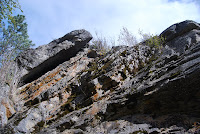
If you know me in RL, you know I really DON'T do heights. However, I did climb this rock face to get close enough to see the glyphs. Jim had to haul both Brody and I up! This is the perspective shot: see him standing at the bottom left of the photo? PLEASE be impressed I climbed that rock! You can see the rock drawings on the top right.

We found a safe place on the ledge to wait while Jim got some close-up photos.

Somebody loves it when we get out and explore the countryside around our valley!


We also didn't know there were petroglyphs in the area. The pile of rock known as Twin Peak One had this one on it:

Here Brody and I are in the *cave* under the glyph:

Then we climbed Twin Peak Two and found this:

If you know me in RL, you know I really DON'T do heights. However, I did climb this rock face to get close enough to see the glyphs. Jim had to haul both Brody and I up! This is the perspective shot: see him standing at the bottom left of the photo? PLEASE be impressed I climbed that rock! You can see the rock drawings on the top right.

We found a safe place on the ledge to wait while Jim got some close-up photos.

Somebody loves it when we get out and explore the countryside around our valley!

Subscribe to:
Posts (Atom)


